Bridal Shop Reports: Which Numbers to Check, and When
Most shop software comes with dozens of reports, and knowing which one to open is the hard part. It usually depends on the moment: a payment that's run late, the end of the month, or an upcoming trip to market.
This guide walks through those moments, from the weekly check-in to the twice-a-year buying trip. For each one, you'll find which numbers to look at, what they tell you, and what to do next. The advice works with any system, and a short note in each section shows where to find the numbers in CloudBridal.
The year at a glance
| Job | When | Numbers to check |
|---|---|---|
| Chasing money owed | Weekly | Overdue payments, balances on arrived gowns, gowns not yet arrived |
| Closing the month | First week of the month | Sales, cash collected, refunds, sales tax |
| Following up with customers | Monthly | Upcoming weddings with nothing booked, referral sources, favorited gowns |
| Clearing old stock | Quarterly, or before a sample sale | How long samples have been on the floor, when each last sold, what each cost |
| How the shop is doing | Quarterly | Appointments booked, how many brides buy, average sale |
| Reviewing the team | Quarterly | Each stylist's sales, and how many of their brides buy |
| Buying at market | Before each market | Buying budget, what sold by style, what isn't selling, designer margins |
| Planning the calendar | Each season | How full your calendar is, what no-shows cost |
Chasing money owed
Money is easier to collect while a late payment is still recent. A quick weekly look means you're never chasing a bride for her balance the week of her wedding.
What to check:
- Overdue payments. Any installment past its due date. It's already late, so start here.
- Balances on gowns that have arrived. Collect these before the gown leaves the shop. After that, look at any bride who still owes money and is getting married within about two months.
- Gowns that haven't arrived yet. Compare each special order's expected arrival with the wedding date, so you spot a late shipment while there's still time to call the designer.
What to do: set every balance to be paid in full about two months before the wedding. That's roughly when the gown arrives, and before alterations start. Our payment plan calculator builds that schedule while the bride is in the room.
Closing the month
In a special-order shop, sales and cash don't arrive together. When a bride orders a $1,500 gown in March and puts down $450, March's sales go up by $1,500 but March's cash only goes up by $450. The rest of the cash you collect in March is payments on gowns ordered earlier. That's why busy ordering months can feel short of cash and quiet months can feel flush, and why you need to look at both numbers.
Sales land when gowns are ordered. The cash keeps coming for months.
Three $1,500 gowns, ordered in January, February and March, each with a $450 deposit and five monthly payments of $210.
- Jan$1,500$450
- Feb$1,500$660
- Mar$1,500$870
- Apr$630
- May$630
- Jun$630
- Jul$420
- Aug$210
January to March: $4,500 in sales, $1,980 in cash. April to August: no new sales, $2,520 in cash.
Hover or tap a month to see where its cash came from.
Show as a table
| Month | Sales | Cash | Deposits | Earlier gowns |
|---|---|---|---|---|
| January | $1,500 | $450 | $450 | $0 |
| February | $1,500 | $660 | $450 | $210 |
| March | $1,500 | $870 | $450 | $420 |
| April | $0 | $630 | $0 | $630 |
| May | $0 | $630 | $0 | $630 |
| June | $0 | $630 | $0 | $630 |
| July | $0 | $420 | $0 | $420 |
| August | $0 | $210 | $0 | $210 |
What to check:
- Sales, by item type and by stylist. This tells you whether the shop is growing.
- Cash collected, by payment method. This is what pays rent and payroll. When you match it against your bank statement, allow for card fees and the day or two card payouts take to arrive.
- Refunds and adjustments. One big refund can make a month look wrong.
- Sales tax, split by rate, for your filing. Ask your accountant whether to count it by the date of sale, the date the order was picked up, or the date it was paid, and use the same basis every month.
- Tips by staff member, if your shop accepts tips, so payroll pays out the right amounts.
What to do: if sales keep running well ahead of cash even outside your busy ordering season, check whether brides are falling behind on their payments.
Clearing old stock
A sample earns its spot on the rack by getting tried on and bringing in special orders. Once it stops doing that, it's taking up space a new style could use, and it's worth a little less every month. Checking once a quarter keeps the problem small.
What to check:
- How long each sample has been on the floor. After about 12 to 18 months, most styles have brought in most of the orders they're going to.
- When it last sold. A gown that's been in the shop 18 months without a sale in the past year is the clearest candidate. One that brought in an order last month is still working, however old it is.
- Discontinued styles. You can't take special orders on them anymore, so the sample is all that's left to sell. These go first.
- What you paid versus the tag price. This tells you how far you can mark a gown down before you're selling at a loss. Sometimes selling below cost is still the right call, because the rack space is worth more.
- The total cost of your aged stock. That's money you've already spent, and every aged gown still on the rack counts against your next buying budget.
What to do: mark each gown down once, based on its age and condition, to a clean new price rather than a series of small cuts. If the designer still sells the style, check your agreement before you advertise the discount. Our sample markdown planner suggests a price, and our sample sale guide covers running the sale.
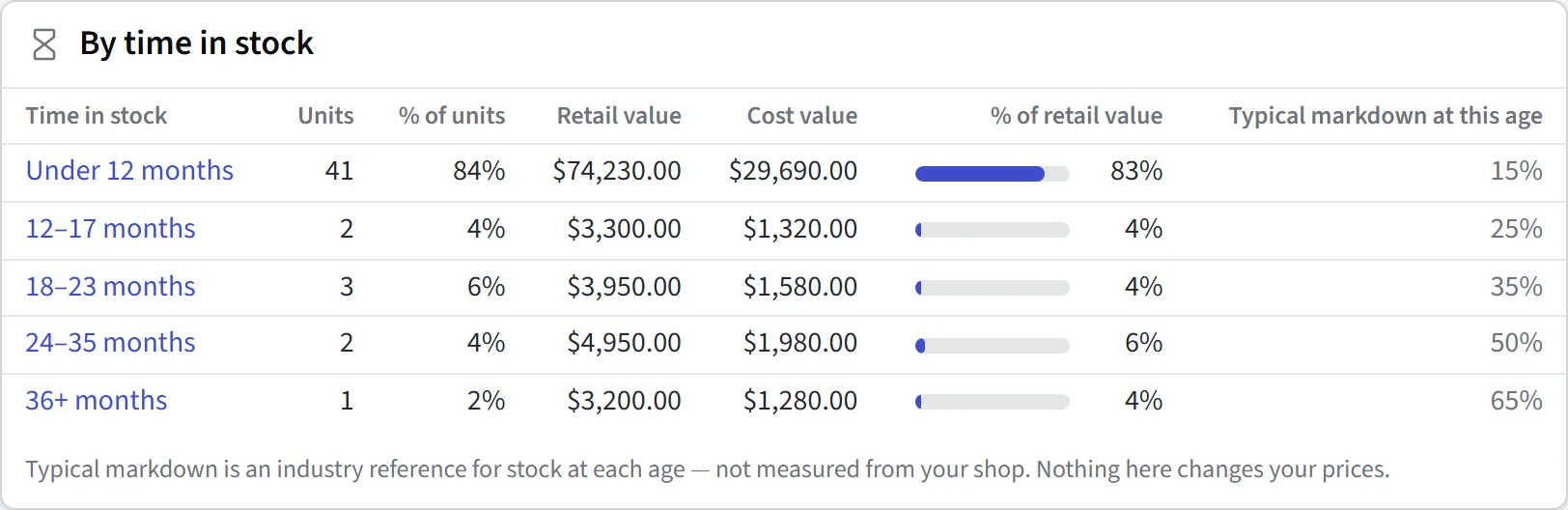
Stock Aging & Markdown groups your stock by how long it's been on the floor and shows the typical markdown for each age. Figures are from a demo shop. Scroll sideways to see every column.
Buying at market
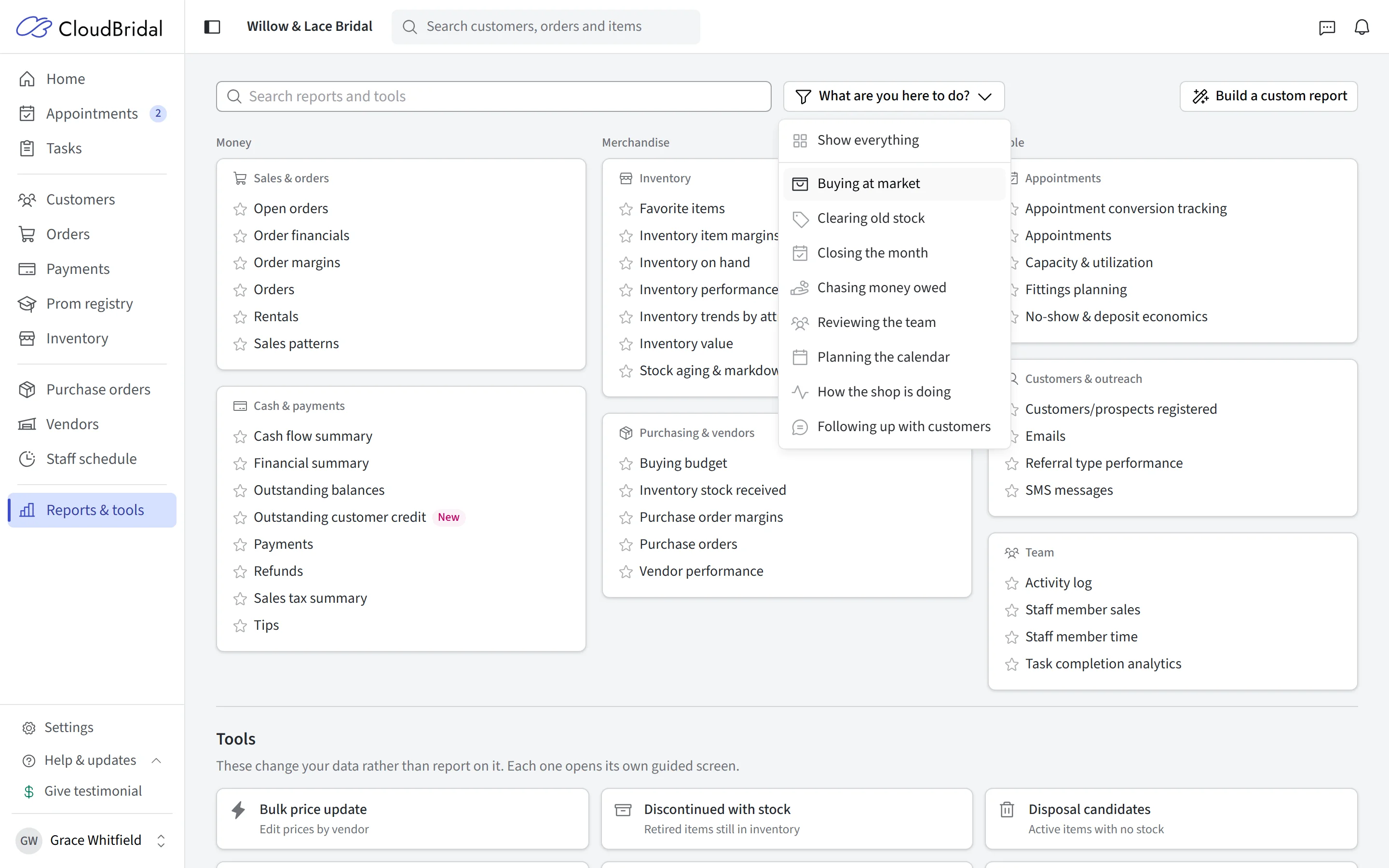
Everything at market pushes you to buy: new collections, friendly reps and show specials with a deadline. Looking at four numbers before you go keeps your order grounded in what actually sells in your shop.
What to check:
- Your buying budget. How much you can spend without ending the season with too much stock.
- What sold, by style. Look at silhouette, neckline, fabric and size across all your designers. If fit-and-flare gowns outsold ball gowns two to one, your order should lean the same way.
- What isn't selling. Check how long each style has been on the rack, and don't buy a newer version of a silhouette that isn't moving.
- Designer margins. The markup you actually made on each designer, and how much discounting it took. For special orders, use what you really paid on the purchase order.
Retailers set the budget with a formula called open-to-buy. Add up the sales and markdowns you expect this season and the stock you want left at the end of it, then subtract what's already on the rack or on order. Divide the result by your markup to get the wholesale amount you can spend. Our open-to-buy planner does the math for you, and How Many Wedding Dresses Does a Bridal Shop Need? explains it in more detail.
One adjustment for bridal: when a bride orders a gown, the designer makes a new one just for her, and your sample stays on the rack. So those orders don't use up any stock, and they don't belong in the formula. What does leave your rack is samples: ones you sell off the rack, sell at a sample sale, or retire. Your budget replaces those, plus any growth you want. For example, if you have 60 samples, expect about 12 to leave this season and already have 4 on order, you'd buy about 8 at market. Veils, accessories and anything else you sell straight off the shelf work the way they would in any store.
Judge each sample by the orders it brings in. Say a sample costs you $750 from the designer. Every time a bride orders that style, you order her a new gown for about $750 and sell it for about $1,950 (a typical 2.6× markup), keeping around $1,200. The first order alone more than covers what the sample cost. A sample that no longer brings in orders is taking up a spot on the rack that a new one could be earning from, which is why it's worth replacing.
What to do: keep 10–15% of the budget in reserve for the style you didn't expect to fall for. If the budget comes out below zero, you already have more stock than you need, so go to this market to look, not to buy.
The rest of the year
These come up less often, and each one comes down to a single idea.
- Following up with customers (monthly). Look for brides with a wedding coming up and no appointment booked, which referral sources bring in brides who actually buy, and gowns that get saved as favorites but rarely sell.
- How the shop is doing (quarterly). Three numbers drive most of your gown sales: how many appointments you book, how many of those brides buy, and the average sale. If 50% of your brides buy instead of 40%, that's 25% more revenue from the same calendar. Are Bridal Shops Profitable? shows how the three fit together.
- Reviewing the team (quarterly). Look at each stylist's sales and how many of their brides buy. Compare stylists on the same kind of appointment, because a stylist who mostly handles first visits will usually sell to fewer brides than one who handles return visits.
- Planning the calendar (each season). Filling empty appointment slots is the cheapest way to grow. Adding rooms or staff only pays off once you're turning brides away in your busy months. Our capacity planner and no-show calculator can help.
FAQs
What reports should a bridal shop run? Four regular ones: overdue payments and open orders every week, sales and cash at the end of each month, stock age before any markdown, and a buying budget and style-by-style sales before each market.
Why don't my monthly sales match my bank deposits? Because special orders are paid for over several months. This month's cash includes payments on gowns sold earlier, and this month's sales include money you won't collect until later.
If I only check one number each week, which should it be? Overdue payments. That money is already late, and it gets harder to collect the longer it's left.
Going to market soon? The open-to-buy planner turns your sales, stock and orders into a buying budget and a sample count to take with you.